Marvel’s sky-high explosions. Fortnite’s goofy dances. Computer graphics are baked into nearly everything we see on a screen. Yet, ask a roomful of people the difference between CGI and 3D animation and you’ll hear a dozen clashing answers. Some treat them as the same thing. They’re not.
Top studios producing advertisements, films, or video games, discarding that distinction isn’t simply a linguistic error—they can alter costs, timelines, and even the creative aspects of the experience. That is why the same fireball that looks spectacular in Avengers is received differently when one is attempting to dodge it in the game.
[elementor-template id=”13845″]
What Is CGI?
CGI, or computer-generated imagery, is the catch-all term. If a computer had any hand in the visuals, it’s CGI. That could mean a simple Photoshop poster… or a dragon shredding a castle wall.
Most people, though, picture CGI as “movie magic.” Consider Pixar, the liquid metal baddie in Terminator 2, or any of the summer action spectacles that take big headlined stars and greenscreen them to everything for a digital visual. The secret is how well those digital ingredients are combined. When it’s done well, you lose track of what is real and what is not.
In plain terms: if a computer spat it out, it counts as CGI.
What Is 3D Animation?
Now zoom in. Inside CGI lives 3D animation. The focus here is motion, not stills. Artists sculpt models with depth, rig them with digital skeletons, and move those rigs like puppets.
The workflow is part art, part math. An animator begins by defining a handful of principal positions, termed keyframes, and the magic machine stitches them together. That way, a character who has the ability to blink animatedly, suddenly sprint, or smile mischievously does not require the painstaking effort of combing through every frame to capture.
Compared with old-school 2D (redraw everything, frame after frame), 3D frees artists up to worry less about repetition and more about how believable the movement feels.
Here’s the quick rule of thumb:
- Every 3D animation = CGI.
- Not every CGI = 3D animation.
A static car render? CGI. That same car drifting around a corner? Now you’re in 3D animation territory.
A Brief History: Why People Get Confused
The fuzziness between CGI and 3D animation partly comes from their timelines overlapping.
Early Motion Tricks
Long before computers, artists had hacks for simulating movement. The phenakistoscope (1832) spun drawings fast enough to look alive. By the early 1900s, cartoons were rolling, and in 1928 Steamboat Willie paired animation with sound—groundbreaking at the time.
Cel Animation’s Golden Run
From the ’30s through the ’80s, cel animation reigned. Characters were inked on clear sheets, layered over backgrounds, and shot frame by frame. Painstaking, but it gave us Snow White, Sleeping Beauty, and eventually The Lion King.
Computers crept in during the ’80s—mainly for coloring and editing—but hand-drawn was still the backbone.
The 3D Takeover
Meanwhile, experimental labs in the ’60s were playing with wireframes. They were crude, but promising. Then came the big break: Pixar. In 1995, Toy Story hit theaters as the first full-length 3D animated film.
That one release flipped the industry. Studios steeped in cel animation shifted almost overnight. Today, 3D animation services are the standard. Hand-drawn survives, but more as a stylistic or niche choice.
CGI and 3D Animation in Movies vs. Games

Both industries lean hard on digital visuals, but the execution is night and day. That’s why a Marvel battle sequence feels cinematic, while a boss fight in Elden Ring feels responsive and alive.
- Rendering time: Films don’t care if a frame ties up a render farm all night. Games need 30–60 frames per second, live.
- Camera control: Directors fix a movie camera. Players spin theirs however they like. Assets need to hold up from every angle.
- Movement cycles: Film characters follow a set script. Game characters need a full library of motions—idle, crouch, run—and smooth transitions between them.
- Visual cues: Explosions in film are a spectacle. In games, they often double as “don’t step here” warnings.
- Performance trade-offs: Games simplify models, trim texture sizes, and pre-bake lighting to keep frame rates stable. Mobile makes this balance even tougher.
Drawing the Line
The simplest way to keep it straight:
- CGI is the whole toolbox.
- 3D animation is one of the tools inside it.
The CGI Pipeline
Making CGI isn’t just pressing “render.” Studios follow a three-stage pipeline to keep order.
Pre-production
- Develop concept
- Write script
- Storyboard scenes
- Test timing with animatics
- Lock character and environment designs
Production
- Layout scenes
- Model props and characters
- Texture surfaces
- Rig skeletons
- Animate
- Add VFX (smoke, water, fire)
- Light the scenes
- Render outputs
Post-production
- Composite layers
- Sprinkle in 2D effects
- Grade colors
- Final render
Studios like Prolific Studio stick to this process—not just for efficiency, but so clients can stay looped in at every milestone.
Why Games Complicate Things
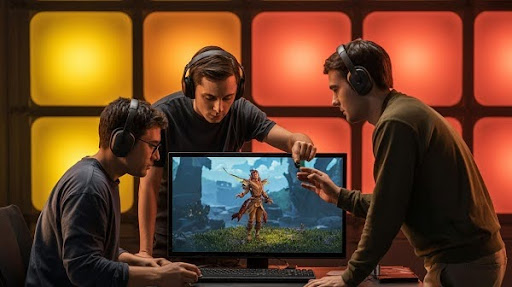
Now add interactivity. Game animation has to adjust on the fly.
- 3D layouts test gameplay before final art exists.
- Rigs cover a wide range of possible movements.
- VFX double as gameplay signals.
- Assets must run smoothly across PCs, consoles, and phones.
That’s why CGI in games feels different from film. The base pipeline looks the same, but the execution bends to give players control.
Beyond Movies and Games
In 2023, the global animation sector was estimated to be worth roughly $374 billion, with CGI and 3D animation representing about 65% of this total.
Most people think of CGI and 3D animation in the same breath as Marvel blockbusters or PlayStation games. But the truth is, these visuals creep into far more places than we notice. They quietly shape medicine, education, marketing, and even real estate.
Advertising and Branding
Ten years ago, a sneaker ad was just glossy photography. Today, a brand can drop a hyper-detailed CGI render that looks even sharper than reality. Add animation, and the shoe bends, spins, or bursts apart midair to show off the tech inside. That kind of control isn’t just eye candy—it sells.
For agencies, the line is practical. If the campaign needs one killer still, CGI does the trick. But the second someone says “make it move,” you’ve entered 3D animation territory.
Architecture and Real Estate
Architects once lugged around foam models and blueprints. Now, CGI gives them lifelike stills of apartments, offices, even whole cityscapes. Introduce 3D animation, and all of a sudden, a buyer can take ‘virtual’ strolls through the lobby, gazing at curtains that sway in a non-existent breeze, or listening to a tap that has imaginary water running in it.
That shift makes a pitch feel less like imagination and more like experience.
Healthcare and Education
Doctors and teachers are in on it, too. Medical students practice procedures on animated human models instead of cadavers. A biology class can swap chalkboard diagrams for CGI atoms, then switch to animation to show them colliding and bonding. The instant those diagrams move, you’ve crossed into animation.
VR and AR
Virtual and augmented reality run on both. CGI sets the scene; 3D animation breathes life into what’s inside. Without that mix, a headset demo would look like a cardboard cutout instead of an immersive world.
Key Technical Differences Between CGI and 3D Animation
The overlap confuses people because the software is often the same. The goals, however, split.
- CGI is the big umbrella. It covers still renders, composites, or any visual cooked up by a computer. That could mean a photo-real car, a Photoshop matte painting, or crowd duplication in a film. The strength lies in flexibility—but the term can get fuzzy if clients want specifics.
- 3D animation is narrower. Its sole job is motion. Characters running, cameras moving, objects reacting. It takes more planning—rigging, keyframing, simulation—but pays off in movement that feels alive.
If you need a quick analogy: think of CGI as a library. 3D animation is one shelf in it, the shelf dedicated to motion.
Why Studios and Clients Should Care

This isn’t wordplay—it affects projects.
Budgets shift hard depending on scope. A single CGI still of a car? That’s a day’s work. But if the brief asks for the same car weaving through traffic, you’re suddenly talking weeks.
Team structure changes too. Static renders lean on modelers and texture artists. Animation demands riggers and specialists who understand movement and timing.
And then there’s the messy part—client expectations. Someone asks for “CGI,” but they’re picturing a full 30-second video. The studio assumes a still image. That mismatch can blow a schedule apart. Sorting out language early saves headaches. At Prolific Studio, this is one of the first conversations we have with clients.
The Tools That Shape the Work
The choice of software depends on the job:
- Autodesk Maya – the industry workhorse for animation and rigging.
- Blender – the open-source favourite, especially for indie teams.
- Cinema 4D – shines in motion graphics and agency work.
- Houdini – unbeatable for smoke, fire, water, and particle-heavy shots.
- Unity & Unreal Engine – dominate real-time work in games and virtual production.
Picking software isn’t about loyalty. It’s about whether the brief leans on still CGI, animation, or both.
Real-World Examples
The theory gets clearer when you see it in action:
- Film: The Social Network used CGI to duplicate one actor into two Winklevoss twins—a static trick. Avatar relied on 3D animation tied to motion capture, giving the Na’vi their lifelike movement.
- Games: Final Fantasy wows the audience with cutscenes that are pre-rendered and boast impressive CGI. Fortnite, on the other hand, real-time 3D animation reigns supreme, with characters seamlessly dancing, sprinting, and having reactions on the spot.
- Marketing: An e-commerce site might feature a crisp CGI render of a sneaker. But the TV ad where that sneaker twists and flexes? That’s animation.
Frequently Asked Questions
Why does the distinction matter?
Because it shifts cost, timeline, and staffing. CGI stills are faster and cheaper. Animation takes longer and needs more hands.
What industries rely on them?
Film, gaming, advertising, healthcare, real estate, education, VR, and AR.
Is CGI usually cheaper than 3D animation?
Yes. Stills need fewer resources. Animation requires rigging, keyframes, and longer rendering.
Which tools are most common?
Maya, Blender, Cinema 4D, Houdini, Unity, and Unreal Engine.
Final Word
Almost every device we use, such as TVs, phones, laptops, and even VR headsets, is powered by computer graphics. The same goes for CGI and 3D animation, which tend to confuse the audience the most.
Think of it this way: CGI is the toolbox. Animation is one of the sharpest tools inside it. Knowing the difference means smarter budgets and smoother timelines.
At Prolific Studio, one of the best animation studios in San Francisco, we help clients make that call. Sometimes the answer is a single powerful CGI render. Sometimes it’s a full 3D animated sequence. Either way, the goal stays the same: visuals that connect and communicate.