Instagram’s focus on video has only grown in 2025. From bite-sized Reels to hour-long Lives, video content is driving engagement on the platform like never before. This comprehensive guide breaks down the latest Instagram video length limits, compares short vs. long-form performance with fresh data, and explores how animation (2D, 3D, and even game animation) can boost your results on Instagram. We’ll also share expert tips for content planning and best practices to help you make the most of each format. Whether you’re a marketer, social media manager, or business owner, read on to learn how to optimize your Instagram videos in 2025 for maximum impact and lead generation.
[elementor-template id=”13845″]
Instagram Video Length Limits in 2025 (Reels, Stories, Feed & Live)
Understanding the rules for each Instagram video format is the first step to crafting an effective content strategy. Instagram now offers several video options—Reels, Stories, in-feed Videos, and Live broadcasts—each with its own time limits and usage nuances. Here are the latest updates for 2025:
Instagram Reels – Up to 3 Minutes for Short-Form Power
Once limited to 90 seconds, Instagram Reels can now be up to 3 minutes long as of early 2025. This update doubled the previous cap and gives creators more flexibility to tell slightly longer stories. Instagram’s head Adam Mosseri explained that they expanded Reels length after hearing that “90 seconds is just too short for those who want to share longer stories”.
- Time Limit: 1 second to 3 minutes (previously 90 sec). In some cases, videos uploaded externally (not via the Reels camera) could run even longer (some sources note up to 15 minutes), but anything over 90 seconds was historically uncommon before this recent update.
- Best Practices: Despite the longer allowance, Instagram’s algorithm still tends to favor shorter Reels (under 90 seconds) for broad distribution. In fact, Reels under ~15–30 seconds often get the highest completion rates and “replay” value from viewers. Use the extra time only if your content truly benefits from it (e.g. a tutorial or narrative that needs up to a couple of minutes). Otherwise, keep it snappy – many top Reels stick to the 15–60 second range to maximize engagement.
Reels remain Instagram’s short-form video powerhouse. They account for over one-third of content consumption on Instagram’s feed, and the platform actively promotes Reels to users who don’t follow you, expanding your reach. In 2025 Instagram continues to prioritize Reels in the algorithm, meaning well-crafted Reels can generate 2× higher visibility than other post types. They also drive superior engagement – one study found Reels boast a 1.23% average engagement rate, higher than photos (0.70%) or carousels (0.99%). Overall, Reels tend to get 22% more interactions than standard IG videos. Leverage that advantage by incorporating Reels into your strategy, using attention-grabbing visuals and trends to stop the scroll. (More on Reels best practices later.)
Instagram Stories – 60 Seconds, Ephemeral and Engaging
Instagram Stories are short-lived vertical videos that disappear after 24 hours (unless saved to Highlights). In 2025, the maximum length of an individual Story video is 60 seconds. This is an improvement from the old 15-second segments limit – previously, any video over 15 sec would be split into multiple Story “cards.” Since late 2022, Instagram allows a continuous 60-second Story, making for a smoother viewing experience.
- Time Limit: 1 to 60 seconds per Story. If you upload a longer video, it will automatically cut into 60-second segments (each segment still appears as a separate Story in sequence). For example, a 2-minute video would become two Story clips.
- Usage: Stories are ideal for real-time updates, behind-the-scenes peeks, quick polls, and daily content that builds a connection with your followers. They appear at the top of the app and, as of recent stats, about 70% of Instagram users watch Stories daily – a huge audience you can tap into with consistent Story posting.
- Best Practices: Since Stories vanish in 24 hours, viewers expect a more casual, unpolished feel. However, it’s still crucial to hook viewers in the first few seconds, as they can easily tap to skip. Use captions or stickers because a significant portion of people watch Stories with the sound off. Instagram’s own team noted that roughly half of users view Stories (and Reels) without sound, so including text overlays or subtitles will ensure your message gets across. Lastly, keep it concise – while you have up to 60 seconds, consider whether your Story might be more impactful as a quick 15-second clip or a series of shorter clips to maintain interest.
Instagram Feed Videos – Long-Form Content (Up to 60 Minutes)
Regular in-feed Instagram videos (sometimes just called “Instagram Video” or formerly IGTV) allow for the longest uploads. These are videos that appear on your main profile grid and in followers’ feeds alongside photos. Instagram merged IGTV and feed videos in late 2021, and now essentially treats any feed-posted video as a Reel in terms of format and discoverability – but longer videos are still possible via feed upload.
- Time Limit: Technically up to 60 minutes. However, for many users the practical limit might be 15 minutes when uploading from mobile (and up to 60 min if uploading from the desktop or if your account is verified/high-following). Instagram still enforces a minimum length of 3 seconds for any video post.
- Algorithm & Format: Videos posted to the feed that are under ~15 minutes will now be treated similarly to Reels, meaning they appear in the Reels tab and can be discovered by non-followers. If you post a very long video (e.g. a 30-minute webinar recording), Instagram may not push it out widely in discovery. Also note that you cannot boost (promote as an ad) a feed video longer than 90 seconds – Instagram only allows boosting shorter videos. Keep that in mind if you plan to turn a post into a paid ad later.
- Best Practices: While you can upload a 30 or 60-minute video, long-form content generally performs better on platforms like YouTube. On Instagram, attention spans are shorter. As the video production team at Yum Yum Videos advises, “avoid uploading hour-long videos (better suited for YouTube); a video under the 5-minute mark could be very interesting for your followers”. In other words, try to keep feed videos relatively short – a few minutes at most – unless you have a very compelling reason to go longer. Use feed videos for “evergreen” content that you want to live on your profile: interviews, product demos, customer testimonials, etc., that viewers can discover anytime. And make sure to include an enticing cover thumbnail and title/description, since these videos sit on your grid and need to attract clicks.
Instagram Live – Real-Time Videos Up to 4 Hours
Instagram Live lets you broadcast live video to your followers in real time, enabling interactive sessions (viewers can comment and send reactions). Live videos are ideal for Q&As, interviews, event coverage, or product launches where you want audience participation.
- Time Limit: Up to 4 hours per live stream. This extended limit (raised from 60 minutes previously) means you can host lengthy live sessions without interruption. Instagram increased the Live cap to 4 hours to support more in-depth streams, which is plenty for most use cases (and frankly, more than most viewers will commit to in one go).
- Engagement Features: Lives can be saved to your profile (IGTV section) after ending, but note they remain available only for 30 days for replays. When you go Live, followers get a notification and your live stream is shown at the front of the Stories bar (with a special “Live” label), which boosts visibility. Live viewers can submit comments and questions in real time, creating a great opportunity for two-way engagement.
- Best Practices: Promote your Instagram Live in advance to get viewers to tune in (e.g. post a Story a day before, and use the countdown sticker). It’s wise to plan an agenda for your Live – even though it’s casual and interactive, having a structure (intro, main topics, Q&A) will keep the session engaging. Given the length, don’t worry about using the full 4 hours; many effective IG Lives might only be 20–60 minutes. Ensure good lighting and sound, and consider having a moderator or colleague help manage comments if you expect a big audience. After the Live, save the video and share it (optionally edit and trim if needed) so that those who missed it can watch later. Lives can also be repurposed – for example, you might edit highlights into shorter videos or Reels.
(Note: Instagram Video Ads follow their own length rules depending on format: e.g. feed video ads up to 60 or 120 seconds, Story ads up to 15 seconds per card, Reel ads ~30 seconds. Since this guide focuses on organic content, just keep in mind that if you plan to run video ads, you’ll need to stick to those shorter lengths. Organic posts that exceed those durations can’t be directly promoted as ads.)
Short vs. Long Videos: Engagement Benchmarks and Insights
Is it better to keep your Instagram videos short and sweet, or can longer videos deliver stronger results? The answer largely depends on your goals, but in general short-form videos dominate engagement on Instagram. Let’s look at the data comparing short vs. long video performance:
- Higher Engagement for Short-Form: Across social media, short videos tend to yield more interactions. On Instagram specifically, users are most likely to engage with videos under 15 seconds. One report found that when interacting with brands, Instagram users prefer very short videos (under 15s) even more than longer “short-form” videos of 30–60s. This aligns with overall trends – marketers consistently cite short-form video as the content type with the highest ROI and engagement in 2025. In fact, short-form video is getting the most increased investment from marketers this year, because it’s what audiences respond to best.
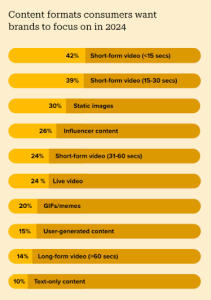
Figure: Content formats consumers want brands to focus on in 2024. Notice that 42% of consumers specifically want very short videos (<15 sec), and another 39% want 15–30 sec videos. By contrast, only 14% want videos longer than 60 seconds【33†】. Clearly, short-form video is in high demand.
- Completion Rates and Retention: Short videos not only attract more engagement, they also hold attention better. About 60% of short-form videos are watched for at least 41–80% of their length on average, which is pretty substantial given their brevity. On the other hand, longer videos often see significant drop-off unless the viewer is highly interested. If your video is more than a minute, you’ll need to work extra hard to maintain viewer interest throughout. Some research suggests that videos around 1–2 minutes achieve the best retention (about 56% average watch time), since they’re long enough to develop content but short enough to avoid losing most viewers. In contrast, extremely short clips (<15s) might get fully watched due to their length, but they could also be swiped past if they don’t immediately captivate. Thus, a sweet spot for many informational or storytelling videos can be in the 30–90 second range – long enough to convey value, short enough to be easily consumable.
- Virality Potential: Short videos are more likely to go viral. Nearly half (47%) of marketers say short-form videos have a higher chance of virality compared to long-form. The quick, snackable nature of short clips makes them easy to share and re-watch. On Instagram, a clever 10-second Reel is far more likely to blow up on the Explore page than a 10-minute feed video. Reels, by design, are optimized for rapid consumption and broad distribution – which is why Reels can generate 2× the impressions of other post types.
- Engagement Rates by Format: If we compare format-wise: Instagram Reels posts see an average engagement rate of ~1.23%, which beats carousel posts (~0.99%) and certainly traditional long videos or static images. This higher engagement is partly because Reels often reach beyond your follower base. In general, Instagram videos (of any length) get about 21% more engagement than static image posts on average. Users spend 60% of their time on Instagram watching videos now, so video content in general is a must for engagement – but keeping it concise tends to amplify the effect.
- When Longer Videos Make Sense: While short-form should be a staple of your strategy, longer videos can play a role too. Live videos (which are inherently longer format) are great for deepening community engagement among those who join – viewers who tune into a Live may stay for 10, 20, even 30+ minutes if the content is valuable to them. Long pre-recorded videos (several minutes up to an hour) posted on IG can serve niche purposes: for example, a detailed product tutorial, an interview or panel discussion, or a saved live webinar. These won’t get the quick viral lift of a Reel, but they cater to your most interested followers who are seeking more in-depth content. If you pursue long-form, watch retention metrics in Insights – see what timestamp users tend to drop off, and use that to improve future videos (perhaps by making them shorter or more dynamic). Also consider breaking a long video into a series of shorter clips for Instagram: for instance, instead of one 10-minute how-to video, you might create a carousel or sequence of 1-minute videos, each covering one tip, which can be more digestible.
Bottom line: To maximize reach and engagement on Instagram, lean heavily into short videos – especially Reels and Stories under a minute. They generate 2.5× more engagement on average than long-form videos and align with what most users want to see. Use longer videos sparingly and strategically, where they add value (e.g., complex explainers, live events, saved streams). Often, a mix of formats works best: hook new audiences with catchy short clips, then engage your core followers with occasional longer content that tells a deeper story.
Read also: Why Explainer Videos Still Outperform Other Video Formats
How Animation Enhances Instagram Video Performance
One powerful way to make your Instagram videos stand out – regardless of length – is through animation. Animated content has exploded in social media marketing because it’s eye-catching, easy to consume, and highly versatile. From playful 2D cartoons to slick 3D motion graphics to video-game style animations, these visuals can give your Instagram videos an extra edge in capturing attention and driving engagement.
Why does animation work so well on Instagram? Here are a few key advantages:
- Capturing Attention Instantly: In a fast-scrolling feed, you have only a second or two to grab someone’s attention. Animations, with their dynamic movement and creative visuals, naturally draw the eye more than static photos or plain talking-head videos. The motion itself causes users to pause. Marketing studies confirm that animated ads and posts tend to stop the scroll effectively. Instagram’s own team noted that dynamic content is often at the heart of viral social media posts. For example, a colorful animated character popping into frame or text that dances on screen can immediately pique curiosity as someone swipes through Stories or Reels.
- Boosting Engagement and Shares: Animated videos frequently receive higher engagement rates than non-animated content. The novelty and entertainment factor of animation encourages viewers not only to watch, but to like, comment, and share. Think of those animated infographics or funny cartoon Reels that rack up shares – the creative format makes viewers want to tag friends or repost. One article notes that brands use animations to turn regular posts into potential “viral sensations”, with the interactive and fun nature of animations prompting more likes and comments. In short, animations are memorable and shareable. If you have a message that might seem dry in text, presenting it with engaging animations can significantly increase how much your audience interacts with it.
- Enhancing Brand Recall: Animation combines imagery, motion, color, and often a storyline – a potent mix for memory. Viewers are more likely to remember an animated video compared to a static image or plain footage. Moving graphics with a clear visual style can imprint your brand in the viewer’s mind. For instance, an animated logo outro on all your videos can reinforce brand recognition. According to marketing experts, using animation in ads helps embed your message in viewers’ memories, improving recall of your brand and campaign. This is especially useful on Instagram where users see countless posts a day; an inventive animation can ensure your content isn’t forgotten moments later.
- Explaining Complex Ideas Simply: Have a complicated product or service? Animation is your friend. Explainer videos using 2D or 3D animation can break down complex concepts into engaging visuals that are easy to understand. Rather than a person talking into the camera with a lengthy explanation, an animation can visualize abstract ideas (like software workflows, data, or processes) in a clear and entertaining way. This is why many tech and finance companies use animated explainer clips on Instagram – it’s an accessible format for the audience. Animations are great for tutorials, how-to content, or telling a story that might be hard to film in real life. As one agency put it, animation’s versatility “makes explaining complex features easier”. Viewers can quickly grasp your message when you show it via illustrations or 3D demos.
- Unique and On-Brand Aesthetics: With animation, you have full control to create a visual style that matches your brand identity. Whether it’s a quirky 2D cartoon vibe or a sleek 3D futuristic look, the style possibilities are endless. This helps differentiate your content. Many brands incorporate a signature animation style into their social videos so that when a user sees that content, they instantly recognize the brand (even before seeing the username). Consistent use of brand colors, characters or motion graphics in your Instagram videos can strengthen brand recognition and professionalism.
- Optimized for Mobile Viewing: Instagram is a mobile platform, and animations – especially motion graphics and 3D – can be designed to look great on small screens. They don’t rely on audio (animations often have text or visual-driven narratives), which is perfect since many people watch without sound. A high-quality animated video with subtitles or on-screen text is immediately understandable even on mute. Plus, formats like animated GIFs or looping short animations fit well into Stories and Reels, providing a smooth viewing experience on mobile devices.
In summary, animation is a game-changer for digital promotion on Instagram. Businesses are increasingly turning to animated content because it delivers more engagement, better recall, and even higher conversion rates than static images in many cases. Now, let’s look at how you can use different types of animation – 2D, 3D, and game-style – in your Instagram strategy, with examples of each.
2D Animation Use Cases on Instagram
2D animation refers to flat, two-dimensional animated graphics – think of classic cartoons, animated explainer videos, or motion graphics with text and icons. On Instagram, 2D animated videos are popular for brand storytelling and simplifying messages.
How 2D Helps: This style is often playful and universally appealing. Marketers use 2D animation to create explainer videos, mini ads, or educational clips that can quickly communicate a value proposition. For example, a fintech startup might post a 30-second 2D animated video illustrating how their app works: instead of just talking about features, they show an animated character encountering a problem and using the app for a solution. This kind of content can significantly boost viewer understanding and interest. Tech companies frequently rely on animations to explain complex software in a friendly way. Instagram viewers scrolling by can immediately get the gist of your message from the visuals alone.
Example: One real-world use case is in the education and non-profit sector. An organization might use 2D animation to explain a social issue or campaign. For instance, an animated video raising awareness about a health topic can condense facts into an engaging story that viewers will watch till the end. The Burp Studio (an animation agency) shared a case study on Instagram where they created a compelling 2D animated video to explain breast cancer statistics and facts in a digestible way – something that could be hard to engage people with via text alone.
For marketers, 2D animations are relatively cost-effective to produce and versatile. Use them for Instagram ads or organic posts that need a creative twist. Product demos, how-to guides, brand story videos, or even meme-style content can all be done with 2D animation. The key is to keep the visuals aligned with your brand’s personality (be it fun, elegant, minimalist, etc.) and to focus on storytelling – even a 20-second animated clip should have a clear beginning, middle, and end that delivers a message or emotion.
3D Animation Use Cases on Instagram

3D animation adds an extra dimension of realism and depth. These are videos with three-dimensional modeled elements, which could be as simple as a 3D logo flying around or as complex as a fully animated 3D character or product. On Instagram, 3D animations are eye-popping and great for showcasing products or creating immersive visuals.
How 3D Helps: If you have a physical product, 3D animation lets you show it off from every angle in a polished way. For example, an e-commerce brand can use a 3D product animation to highlight the features of a new gadget: the camera could sweep around a digital 3D model of the product, zoom in to show details, and explode it into parts to demonstrate the engineering – all in a slick 15-second Instagram video. This approach can engage viewers far more than static photos. In fact, many retail and e-commerce businesses find animated ads effective for promoting items and driving clicks. Animated Instagram videos can demonstrate how a product works (like an espresso machine brewing coffee via animation) and create a sense of urgency or excitement for sales.
3D animation is also widely used in industries like real estate and architecture on Instagram. Developers often share 3D rendered walkthroughs or flyovers of properties. A beautifully animated 3D tour of a new real estate development – showing the building exterior, then moving inside to furnish rooms virtually – can captivate viewers and serve as a virtual open house. These virtual tours leverage Instagram’s visual nature to get potential buyers interested. Real estate ads using 3D animations of floor plans or amenities have seen success in grabbing attention, as noted by marketing agencies.
Example: A car brand could post a 3D animated clip of a new car model drifting through a stylized environment (with all the shine and polish of 3D graphics) to create buzz before the car’s release. Prolific Studio, one of the best animation studios in LA, shared a recent Instagram video of a drifting car rendered in 3D, showcasing how a “lot of 3D magic” can produce a captivating visual that gets auto enthusiasts hyped about a vehicle. The animation’s realism and dramatic motion instantly stand out in the feed.
Use 3D when you want a high-impact, professional look. It’s perfect for product-centric industries (tech gadgets, fashion accessories with 360° views, automotive, architecture, etc.). Do keep an eye on file sizes and formats (Instagram supports common video files, but very heavy 3D animations need to be optimized to meet the 4GB file size limit and to play smoothly). Also, ensure the first frame or cover image is intriguing – perhaps a stunning 3D scene – to entice users to tap “Play.”
Game Animation (Gaming Content) Use Cases on Instagram
“Game animation” refers to animated content either derived from video game visuals or created to promote games. It can include everything from game trailers and cinematics to stylized animations that use game art or characters. Even if you’re not a game developer, you can take inspiration from game-like animation for creative marketing content (for example, a brand making an 8-bit retro-style animated Reel just for fun).
How Game Animations Help: The gaming industry heavily uses Instagram to build hype for new releases. Eye-catching animated teasers are key. Gaming studios rely on animated Instagram videos to generate buzz – they often share short trailers, character animations, or cinematic snippets from the game. These are essentially ads for the game, but done in a way that entertains the audience. The excitement of a well-crafted game trailer can lead to tons of shares among the gaming community. For instance, a 30-second trailer showing epic gameplay moments or story cut-scenes can get fans talking and counting down to release day. This concept applies to non-gaming brands too: you can use a “gamified” style of animation to create excitement around your product. Perhaps an outdoor gear brand creates an adventurous animated story that feels like a level from a video game – it’s a way of making the marketing fun and engaging.
Example: Consider how movie studios promote animated films – they drop short character introduction clips or fun animated shorts on Instagram. A gaming analogy: a company releasing a new RPG might post a quick animation of the hero character performing a signature move. This not only shows off the game’s art but also gives a taste of the story, hooking viewers. Even outside of entertainment, interactive or game-like animations can work wonders. A fashion brand could do an Instagram Story where an animated avatar “tries on” different outfits in a game character style selection screen – a creative twist that grabs attention.
For businesses not in the gaming sector, partnering with creative studios to produce game-inspired content can differentiate your social feed. For example, using pixel art animation for a Throwback Thursday post, or a short animated game where tapping the Story fast simulates a simple “choice” can amuse your audience. It’s all about interactive storytelling. Keep these animations shorter (Reel or Story length) and focus on the wow factor – game animations are competing for the attention of a young, entertainment-savvy audience, so high-quality visuals and sound (if applicable) are important. When done right, they not only boost engagement but can also drive conversions (e.g. game studios often see direct click-throughs to pre-order pages from Instagram when a trailer goes viral).
Leveraging Animation: In-House vs. Partnering with Experts
While animations can significantly enhance your Instagram performance, not every brand has an animation team on staff. This is where working with specialized studios can pay off. Prolific Studio, for example, is a professional animation production company that offers 2D, 3D, and game animation services for marketing content. If your goal is to create scroll-stopping animated videos but you lack the time or skills in-house, partnering with an experienced studio can ensure you get high-quality results without a huge learning curve.
Animation experts will help tailor the content to Instagram’s specs and your brand’s objectives. They can advise on the optimal length, style, and format for each platform. For instance, Prolific Studio’s team has created everything from 2D explainer videos ideal for Instagram campaigns to 3D product demos to full gaming trailers for promotional use. By collaborating with pros, you can bring ambitious ideas to life – whether it’s an interactive Story ad or a series of animated Reels – while you focus on your broader marketing strategy.
When seeking a partner, look for animation studios with social media experience specifically. Creating for Instagram’s vertical format and fast pace is a bit of an art in itself. The right partner will know how to deliver your message in the first seconds, design for sound-off viewing, and keep the style consistent with your brand. Ultimately, investing in some animated content can elevate your Instagram presence and set you apart from competitors who stick to only live-action footage or static graphics. It’s an investment not just in visual appeal, but in better performance: as we’ve seen, animated posts can lead to more views, higher engagement, and better conversion outcomes.
Best Practices for Instagram Video Success in 2025
Now that we’ve covered the formats and the power of animation, let’s summarize some best practices and expert tips to help your Instagram videos thrive:
- Grab Attention in the First 3 Seconds: The start of your video is critical. Users scroll quickly, so avoid slow intros or fades from black. Begin with a compelling hook – a striking visual, a bold statement (in text overlay), or an engaging action. For example, instead of starting a product demo with your logo, start by showing the product solving a problem or a before-and-after reveal. If you fail to intrigue viewers immediately, they’ll scroll past. Remember, on Reels and Stories, the viewer decides within a heartbeat whether to keep watching. As one Instagram expert noted, you should design videos to “stop the scroll” with movement and excitement right away.
- Keep It Short (Generally): As the stats showed, shorter videos usually perform better on IG for reach and engagement. Aim for 15–60 seconds for most content, especially Reels. You can absolutely use the 90-second or 3-minute limit when needed, but always ask: could this message be delivered more concisely? If yes, trim it down. Shorter videos are more likely to be watched in full and shared. That said, don’t cut important info just to be short – if you have a compelling 2-minute story, by all means use that length (it might achieve 50%+ retention which is great). The key is match the length to the content: simple updates = short; deeper narrative or tutorial = longer but engaging throughout.
- Optimize for Silent Viewing: A large portion of Instagram users watch videos with sound off (estimates range from ~50% to as high as 80% depending on content type). Always include captions or on-screen text to convey your message without audio. Use Instagram’s caption sticker for Stories or burned-in subtitles for Reels and feed videos. This not only makes your content accessible (including to those with hearing impairments) but also increases average watch time – because people can follow along even if they can’t play audio at that moment. If you’re talking to camera, consider adding dynamic text callouts of key points to keep visual interest.
- Leverage Hashtags, Tags and Captions: Don’t forget the context around the video. Write an interesting caption to draw people in or prompt engagement (a question, a concise summary, etc.). Use relevant hashtags to improve discoverability, especially on Reels which can appear on Explore for certain topics. If appropriate, tag locations or other accounts (for example, tag a partner brand or an influencer featured in the video). According to video marketing experts, these elements can amplify reach by making your video more searchable and shareable. Just avoid clickbait or overly long caption text – Instagram users prefer captions that are short and to the point (with maybe a couple of emojis for personality).
- Use Trending Audio & Effects (When Suitable): Audio is a big part of Instagram Reels culture. Using a trending sound or music can increase the chances of your Reel being favored by the algorithm (since popular audio often gets a boost). If it fits your content, consider incorporating popular songs or viral sound bites – but ensure it aligns with your message. Likewise, Instagram’s built-in effects and filters can add pizzazz to your videos. Transition effects, green screen backgrounds, and AR filters are tools to make your content more engaging. Jumping on fun trends (like a popular transition challenge) can humanize your brand and make it more relatable. Just balance trend participation with authenticity; choose trends that make sense for your brand voice.
- Maintain High Quality (Visual and Audio): In a crowded content feed, production quality still matters. Bright, clear visuals and crisp audio will outperform shaky, hard-to-hear footage – unless the content is extremely compelling otherwise. Aim for 1080p resolution or higher and good lighting. Use the right aspect ratios (9:16 vertical for Reels/Stories, 1:1 or 4:5 for feed if not vertical) so your video displays optimally. While you don’t need Hollywood-level production for every Instagram video, basic attention to quality (steady camera, appealing composition, readable text, etc.) will reflect well on your brand’s professionalism. Also, Instagram’s algorithms do downrank extremely low-quality videos (blurry or pixelated content), so ensure your uploads meet the recommended specs.
- Post Consistently, But Focus on Value: Consistency is key on social media, but there’s no hard rule that you must post video X times per week. It’s better to maintain a sustainable schedule with content you’re proud of, rather than forcing daily videos that feel low-effort. Many experts suggest aiming for at least 1–2 video posts per week on Instagram to stay relevant, but you can adjust based on your resources. The Yum Yum Videos team advises that quality trumps quantity – if you need to post a bit less frequently to ensure each video is top-notch, do so. Over time, you can increase frequency as you get into a groove with planning and producing content. Use Insights to gauge if posting more often correlates with better results or if certain days/times get better engagement.
- Plan Your Content Calendar with Mix of Formats: For effective content planning, map out how you will use each Instagram video format to serve a purpose. For example: you might schedule Stories daily for casual behind-the-scenes updates or quick polls (high frequency, low production effort), Reels 1-3 times a week for broader reach and creative content (medium production effort), Feed videos (IGTV-style) perhaps once a week or month for deep-dive content like interviews or customer testimonials (lower frequency, higher effort), and Instagram Live maybe once a month for real-time engagement events. This multi-format approach ensures you’re leveraging the strengths of each. Make sure to also repurpose content across formats – a great Live session can be edited into a highlight Reel; a series of Story tips can be compiled into a longer video. Such repurposing extends the life of your content (and justifies the effort spent creating it).
- Monitor Performance and Adjust: Pay close attention to your Instagram Insights (or other analytics tools) to see how your videos are performing. Note the engagement rate, reach, and retention time of your videos. Do your 15-second Reels consistently outperform your 60-second ones in views or completion? Does a certain topic or style of animation get more saves and shares? Use this data to refine your strategy. Instagram trends can evolve quickly, so a format that worked great last year might need tweaking now. For instance, if you notice Reels reach dropping (Instagram did report some declines in organic reach in 2023), you may experiment with new content approaches or additional promotion of your videos. The goal is to continually learn what your specific audience responds to. Optimize length, format, and content type based on those insights for continual improvement.
- Include Clear CTAs: Finally, don’t forget to include a call-to-action when appropriate. If the goal of your Instagram video is to generate leads or sales (which for many marketers it is), be explicit about next steps. Examples: “Visit the link in our bio to learn more,” “Swipe up to shop this product” (for Stories with links or using the link sticker), or even a verbal/text CTA like “Comment below with your questions” to spur engagement. Especially in 2025, Instagram is pushing e-commerce integration – features like Shopping tags in Reels and Stories allow direct product linking. If you have that capability, use it. An animated video showing your product should have it tagged so users can tap and buy in a few clicks. Or if you’re looking to drive sign-ups, an Instagram video ad might end with a CTA button. In organic content, CTAs can be more subtle but still present. Guide the viewer on what to do after watching: follow your page, share with friends, visit your site, etc. A gentle nudge can significantly improve conversion outcomes from your video viewers.
Following these best practices will help ensure your Instagram videos not only attract eyeballs but also contribute to your marketing goals. It’s all about balancing creativity with strategy – make content that people love and that furthers your objectives, whether that’s growing brand awareness, driving engagement, or generating leads.
FAQs (Frequently Asked Questions)
To wrap up, here are 10 common FAQs about Instagram video length and strategy in 2025, along with concise answers to help you quickly find the information you need:
Q2: How long should an Instagram Reel be for best engagement?
A: While Reels can be up to 3 minutes now, short Reels tend to perform best in terms of views and engagement. Many social media experts recommend aiming for 15 to 30 seconds for most Reels. Reels under 15 seconds often have the highest completion rate and are favored by Instagram’s algorithm for discovery. That said, if your content is very engaging, Reels up to 60 or 90 seconds can also do well – especially if telling a story or demonstrating something that needs more time. The key is that the Reel should feel fast-paced and hold attention all the way through. It’s better to have a great 45-second Reel than a choppy 15-second one. As a rule of thumb, try different lengths (15s, 30s, 60s) and check your insights. If you see viewers drop off at, say, 20 seconds consistently, you know to tighten up future videos. Currently, Instagram still often “pushes” shorter Reels to wider audiences, so err on the side of brevity when in doubt.
Q3: What is the time limit for Instagram Stories and how can I post longer Stories?
A: Each individual Instagram Story (video) can be up to 60 seconds long. If you record or upload a video longer than 60s, Instagram will automatically split it into multiple 60-second segments. In the past, the limit was 15 seconds per Story, but Instagram updated this in late 2022 so that 60s videos no longer get chopped into four parts. To post a longer narrative on Stories, you can simply keep recording – the app will create a sequence of Story clips. For example, a 3-minute video will become three consecutive Story posts (1 minute each). Viewers will see them back-to-back seamlessly. Just note that after a lot of consecutive Stories, viewers might start swiping ahead, so it’s best to keep Story series relatively short (a few minutes total at most). If you need to share something very long, consider doing an Instagram Live or an IGTV/feed video. And remember, Stories expire after 24 hours (unless you save them as Highlights on your profile). So for important longer videos that you want to last, a feed post might be more suitable than a Story.
Q4: Are longer Instagram videos (like 5-10 minutes) worth posting, or will people scroll past?
A: Longer videos on Instagram can be worthwhile in certain scenarios. Generally, Instagram users have shorter attention spans, so a 5-10 minute video will not get as many views as a 30-second video. However, the viewers who do watch a longer video are often highly interested in the content. If you have, say, a dedicated follower base or a topic that requires depth (an interview, a detailed tutorial, a story that needs setup), posting a longer video can engage your most loyal fans and deliver value that a short clip couldn’t. A good strategy is to tease the long video with a short version. For example, post a 30-second Reel with highlights and mention that the full 5-minute video is on your profile or IGTV. Also, consider platform fit: Instagram isn’t YouTube – videos over a few minutes may suffer in reach. One workaround some brands use is to split a long video into a multi-post carousel or series (e.g. Part 1, Part 2). This can make it more digestible. So yes, you can post a 5-10 minute video, but make sure the content is highly engaging throughout, and don’t rely on it for virality. It’s more for depth and completeness. Always analyze the retention graph in Insights; if viewers drop off en masse after 1-2 minutes, that’s a sign to shorten it next time or improve the content flow.
Q5: Do short videos really get more engagement on Instagram than longer ones?
A: In most cases, yes. Multiple studies and statistics in 2025 show that short-form videos (generally under 60 seconds, and especially under 15 seconds) yield higher engagement rates on Instagram than long-form videos. For example, Instagram Reels (short by nature) have an average engagement rate of around 1.2%, higher than traditional longer IGTV-style videos or image posts. Short videos tend to get more likes and comments per view, likely because they capture attention quickly and are fully consumed by more viewers. Also, the algorithm gives short videos an edge in discoverability, so they often accumulate more total views. However, “engagement” can also be about quality – a longer video might get fewer likes, but perhaps more meaningful comments or shares from those who find it valuable. Still, if we’re speaking generally: short videos generate about 2-3 times more engagement than long ones on Instagram on average. One stat said short-form videos get 2.5× the engagement of long-form. Moreover, 81% of consumers say they want to see more short videos from brands, so the audience preference leans heavily that way. Our recommendation: use short videos to maximize numbers, and occasionally use longer videos for specific purposes.
Q6: How can I use 2D and 3D animation in my Instagram videos effectively?
A: Both 2D and 3D animations can significantly boost the appeal of your Instagram content. Here’s how to use them effectively:
- 2D Animation: Great for explainers, storytelling, and adding a fun, human touch. Use 2D animated videos to simplify complex ideas – for instance, a quick explainer of your service or a how-to tutorial with animated icons and characters. 2D is also effective for creating branded characters or scenes that convey your brand personality (think of Mailchimp’s quirky doodles or other brands with mascot animations). Keep 2D animations short and focused on one core message or story. The visuals should complement a clear voiceover or text narrative. Ensure the style (color palette, illustration style) matches your brand. Because 2D is “flatter” visually than 3D, it’s often wise to use bold colors, high contrast, and movement to grab attention in the feed.
- 3D Animation: Use 3D when you need sleek, eye-catching visuals or product demos. For example, a 3D animation can showcase a product prototype in motion, or create a virtual 3D environment to demonstrate a concept. Make sure the animation looks polished – low-quality 3D can have the opposite effect, so work with skilled designers or use high-quality templates. 3D intros or transitions can also spice up your normal video (e.g., an animated 3D logo reveal at the start or end of your Instagram video adds professionalism). Remember to optimize for vertical frame if posting to Reels/Stories (don’t let your cool 3D car drive off-screen!). Also, test file size and compression; overly detailed 3D might pixelate on Instagram, so find the right balance between fidelity and performance.
- In both cases, use animation to support your message, not distract from it. A common best practice is to include a call-to-action or key message in text form within the animation, since people will be drawn to the visuals. For example, in a 2D animated ad, you might literally animate the words “Sign up for 50% off!” bouncing on screen – hard to miss. Animated content, when done well, leads to more engagement (people love to comment on cool animations) and can set your brand apart as tech-savvy and creative. Many brands partner with animation studios to create Instagram-specific animated content – for instance, to produce a series of animated tip videos. This can be a smart move if you don’t have in-house animators, ensuring your 2D/3D content looks professional and resonates with viewers.
Q7: What is “game animation” in the context of Instagram marketing, and how can I use it?
A: “Game animation” refers to using video game-style animations or content from games for marketing purposes on Instagram. This can mean a few things:
- Promoting Games: If you’re a game developer or marketer, it means using animations (like trailers, character reveals, or gameplay snippets) to advertise your game. Instagram is a popular channel to build hype for new game releases – short animated trailers or character animation clips can get gamers excited. For example, a mobile game might post a 15-second Reel of animated gameplay highlights with text like “Can you beat this level? Download now.”
- Gamified Content for Non-Gaming Brands: If you’re not a game company, you can still use “game-like” animations to engage your audience. This could be an 8-bit style animated video for nostalgia, a story told through a video game interface, or interactive Story content (like a “choose your adventure” using poll stickers). The idea is to tap into the fun, interactive spirit of games. For instance, a fitness brand might do a Story series where an animated avatar “levels up” as they complete exercises, turning a fitness challenge into a game animation.
- AR Games/Filters: Another angle is using Instagram’s AR filters to create mini-game experiences. While not exactly animation you post as video, brands have made AR filters where users can play a simple game (like catching falling objects with their head movement). Promoting these with an animated demo can encourage followers to try it and share.
Using game animation effectively means ensuring it fits your audience. Gaming content tends to appeal to a younger demographic on Instagram (teens, 20s). If that’s your target, it can be incredibly viral. If not, you might use more subtle game elements. Keep game promos short – flashy action, quick cuts – similar to how you’d see a TV spot for a video game. And always include a CTA (like “Link in bio to play” or a direct install link if using Instagram ads). Done right, game-style animations add a cool factor to your feed and can boost sharing, as gaming fans love to tag friends in anything game-related. Even for serious industries, a surprise gamified post once in a while can pleasantly surprise your followers and humanize your brand.
Q8: What are some content planning tips for balancing Reels, Stories, Lives, etc., in my Instagram strategy?
A: Planning content across all of Instagram’s video formats can feel daunting, but a few tips can help:
- Map Out a Weekly/Monthly Calendar: Decide how often you want to post each format. For example, you might set a goal of 3 Reels per week, Stories every weekday, 2 feed videos per month, and 1 Live per month. This can be adjusted based on results, but having a baseline prevents neglecting any format. Plot these on a calendar so you can visualize the cadence.
- Theme Your Content by Format: Many brands find it useful to assign certain content “themes” to formats. e.g. Stories = daily life and quick updates, Reels = polished, viral-worthy content or product features, Feed videos = in-depth content (interviews, testimonials, ads), Live = interactive Q&A or event coverage. This way, when you brainstorm ideas, you immediately know which bucket they fall into.
- Repurpose Smartly: A big time-saver is repurposing. A single longer video can generate multiple pieces of content. For instance, film a 5-minute interview (could be uploaded as an IGTV/feed video), but also plan moments in it that you can cut into short Reels or Stories. Or vice versa: compile a series of short Tips (Stories/Reels) into a longer montage for your feed or YouTube. Cross-posting is also useful – you can share a Reel to Stories to give it extra exposure. Just be mindful of not being too repetitive for those who follow you everywhere.
- Use Analytics to Guide Timing: Look at when your audience is most active (Instagram Insights shows you peak times). Schedule Lives during those times for maximum attendance. Post Reels on days/times you historically see good engagement. While Instagram’s algorithmic feed means exact timing is a bit less critical than before, it still helps to deliver content when fans are online.
- Maintain Flexibility for Trends: Plan ahead but leave room for spontaneity. If a new challenge or meme trend pops up and fits your brand, jump on it with a quick Reel or Story – even if it wasn’t on the content calendar. That’s the agile part of IG strategy. Maybe leave one “TBD” Reel slot per week for reactive content.
- Batch Production: To stay consistent, try batch-creating content. For example, dedicate one day to shooting/editing all Reels for the week. Many social media managers produce a bunch of Story content in advance (graphics, video clips) that can be posted later with minor tweaks. Lives you can’t batch (since live), but you can definitely script/outline them in advance.
- Content Pillars: Ensure your video content aligns with a few key content pillars or objectives (e.g., Educate, Entertain, Inspire, Promote). Each week check that you have a healthy mix. If all your videos in a week are product promos (Promote), maybe plan an educational how-to Reel or a fun behind-the-scenes Story to balance it.
Balancing formats is about diversifying content without overwhelming yourself. Start with what you can manage, then scale up. The good news is that using all these formats in concert can significantly boost your reach – you’ll engage followers in different ways and signal to the algorithm that your profile is active and worth showing to more people.
Q9: How can I generate leads or conversions through Instagram videos (not just views)?
A: To drive tangible leads or sales from your Instagram videos, you need to incorporate strategy beyond just getting views:
- Include Clear Calls-to-Action: As mentioned earlier, prompt viewers on what to do next. If you have 10k+ followers or a Business account with link sticker access, use the Link Sticker in Stories or clickable links in your bio/description to send viewers to a landing page. In a Reel or feed video caption, write a CTA like “Sign up at the link in our bio for a free demo”. In the video itself, you can have a text overlay that says “Visit our profile to learn more” as it ends. Don’t assume people will hunt for the next step – guide them.
- Use Instagram Ads for Key Offers: The reality is, organic alone has limitations for conversion. Consider promoting your top-performing content. Instagram allows you to turn a video into an ad with a button (e.g., “Learn More”, “Shop Now”). For lead gen, you could even use Instagram Lead Ads which open a lead form within the app. By putting some budget behind a great video (especially a testimonial or product demo), you can reach a targeted audience and capture leads directly or drive them to your site. Remember, keep ads under 60-90 seconds for best results (Instagram’s ad placements often require shorter videos).
- Story Highlights and Bio Links: Use your Instagram profile efficiently. Have a “Swipe Up” (or link sticker) CTA in Stories regularly and save those Stories in a Highlight titled “Learn More” or “Demo” etc., so profile visitors can easily find them later. Keep your bio link updated – there are tools that let you have a mini landing page with multiple links (Linktree, etc.) so you can direct video viewers to the right link (e.g., a specific campaign). You might say in a video caption, “(Link in bio: ‘Free eBook’)” to indicate which link to click.
- Track with UTM and Insights: Treat your Instagram like a funnel. If lead gen is the goal, track how many people click your links or use your promo codes from Instagram. Use UTM parameters on your URLs to see traffic from IG videos in Google Analytics. If you see that a certain type of video yields more site visits or sign-ups, do more of that. Perhaps your animated explainer Reel gets lots of clicks, whereas pure entertainment videos get none – then adjust to include a value prop in most videos.
- Leverage DMs: Many businesses successfully use Instagram Direct Messages for lead nurturing. A tactic: use a Story with a poll or question sticker asking if people want more info; those who respond, you follow up with a DM providing the info or link. Or simply in your video caption say, “DM us the word ‘INFO’ for details.” This can start a conversation that leads to a conversion offline. It’s more manual but very high-touch.
- Show Social Proof: People convert when they trust. Use video to show testimonials, customer success stories, or data points. For example, a quick montage of customer quotes or an interview with a happy client in a video can drive viewers to learn more. Highlight any “free trial” or guarantee to reduce barriers. Essentially, treat your Instagram content like part of your sales funnel – mix in top-of-funnel fun stuff with mid-funnel education and bottom-funnel conversion pushes.
Finally, consistency matters: the more someone sees your helpful video content, the more likely they are to eventually convert. So, keep showing up with value. And when they do convert, consider acknowledging them (maybe an automated thank-you email that references your Instagram, to close the loop and reinforce that connection).
Q10: What are the latest Instagram video trends in 2025 I should be aware of?
A: Some key Instagram video trends in 2025 include:
- Longer Reels (but Short Content Still King): With Reels extended to 3 minutes for many users, some creators are experimenting with longer storytelling on Reels. However, the trend is that while longer options exist, the viral hits are still often under 60 seconds. So the trend is having the ability to go longer, but choosing brevity for mass appeal.
- TikTok-style Editing: Instagram content has taken cues from TikTok’s jump-cut editing and fast pace. Quick transitions, text pop-ups timed to beats, and meme references are prevalent. Even brands are hiring editors to give their videos that snappy, platform-native feel.
- Interactive Elements: Features like Instagram Stories’ interactive stickers (polls, quizzes, emoji sliders) continue to be popular. A trend is incorporating these into video Stories to make essentially interactive micro-videos (e.g., a Story video asks a question, and uses the poll sticker for response). This boosts engagement and retention.
- User-Generated Content (UGC) and Duets: Brands are sharing more UGC videos – for example, reposting a customer’s Reel reviewing their product. Also, the “Remix” feature (Instagram’s version of duets) allows you to have your video side-by-side with another. Companies might remix a fan’s video to add their commentary or thanks. This trend of collaborative content blurs the line between creator and audience.
- AR and 3D Effects: We see more augmented reality effects used in videos. For instance, using AR filters while recording a Reel to place virtual objects or backgrounds (think a person talking about travel while an AR beach scene plays behind them). 3D avatars (like Meta’s avatars) also occasionally pop up in Reels as a fun twist. As AR tech in Instagram improves, expect more creative uses – it’s a trend to watch.
- Vertical Video Ads & Shopping: On the advertising side, brands are fully embracing vertical video for ads. You’ll see Story ads and Reel ads that feel native – often shot on a phone, vertical, with subtitles – because that format performs better. Also, shopping via video is growing: tags on Reels that let you buy products shown, live shopping streams where viewers can purchase in real time, etc. If you’re in e-commerce, integrating product links in your videos is almost becoming standard.
- Authenticity and Behind-the-Scenes: Polished ads have their place, but a big ongoing trend is “authentic” content – lo-fi, behind-the-scenes clips, founder story videos shot in an informal setting, day-in-the-life vlogs in Stories, etc. These build trust and feel more like the content from friends that users are accustomed to. In 2025, audiences continue to gravitate toward brands that show a human side on camera (even if that content is interspersed with high-production promos).
- Cross-platform Influences: Trends don’t live on one platform anymore. A viral format on TikTok or a popular meme on Twitter often becomes an Instagram video trend too. For example, the “photo dump” carousel trend or certain remix audio memes hop between apps. So, staying on top of general social video trends (not just Instagram-specific) is important.
Final Words
In summary, 2025’s Instagram video landscape is about dynamic, short-form content with the option for longer pieces, a continued push for authentic storytelling, and leveraging new features (like Reels updates, interactive stickers, shopping tags) to engage and convert. Keep an eye on the Instagram Creators account and social media blogs for the latest feature releases so you can jump on new opportunities – early adopters of features often get algorithm love! And most importantly, experiment and have fun with it – genuine creativity resonates most with viewers.
Contact Prolific Studio if you want killer animated Instagram reels for yourself or your business, too.